Bilingual Literacy for Learners with Intellectual Disabilities: An Intersectional Position
Disclaimer: This translation was generated using artificial intelligence
Littératie Bilingue pour les Apprenants ayant des Déficiences Intellectuelles : Une Position Intersectionnelle
Introduction et prise de position
Les personnes ayant une déficience intellectuelle (DI) présentent des déficits neurodéveloppementaux à apparition précoce, marqués par une altération significative du fonctionnement intellectuel et adaptatif. Des difficultés dans le fonctionnement scolaire accompagnent généralement cette situation (Lee et al., 2023). Dans les contextes bilingues et multilingues, les personnes ayant une DI sont trop souvent enseignées et évaluées comme si elles étaient monolingues. Ce biais monolingue met systématiquement de côté les répertoires culturels et linguistiques qui façonnent la manière dont les élèves accèdent à l’enseignement et démontrent leurs connaissances (Beatty et al., 2021; García & Lin, 2017). Une posture intersectionnelle, dans laquelle le handicap, la langue et la culture sont considérés comme des dimensions de l’identité et des opportunités qui se façonnent mutuellement, est essentielle pour aider les élèves à atteindre leur plein potentiel. L’implication pratique consiste à intégrer dès le départ les considérations relatives à la bilittératie, au handicap et/ou aux difficultés de littératie dans le curriculum, la pédagogie, l’évaluation et les politiques, plutôt que de considérer les soutiens bilingues comme une réflexion après coup (Bešić, 2020; Wawire & Barnes-Story, 2023).
Le caractère bilingue de longue date de Malte, associé aux récents changements démographiques, a intensifié la diversité linguistique dans les classes ordinaires et accru le besoin de méthodes d’enseignement bilingues et multilingues (Panzavecchia, 2024). Bien que le maltais et l’anglais demeurent les principales langues d’enseignement, de nombreux élèves apportent d’autres langues, ce qui rend les stratégies interlinguistiques, telles que le translanguaging et l’alternance codique pédagogique, à la fois courantes et pédagogiquement nécessaires (Faltis, 2019; Hopewell & Abril-Gonzalez, 2019), en particulier dans un contexte de bilinguisme sans diglossie. Le paysage de l’inclusion amplifie cet impératif. Étant donné qu’à Malte, la grande majorité des élèves ayant une DI sont scolarisés dans des classes ordinaires, avec plus de 94 % dans des établissements ordinaires et seulement environ 5,5 % dans des dispositifs spécialisés (Eurydice, 2025), cela soulève la question de savoir si, et comment, les pratiques bilingues et de bilittératie sont également appliquées aux élèves ayant une DI.
Les cadres internationaux renforcent la notion d’éducation bilingue. La Feuille de route de l’UNESCO pour l’éducation multilingue (2025) et la Convention des Nations unies relative aux droits des personnes handicapées (2013) appellent à un enseignement qui valorise les langues familiales des apprenants dans l’enseignement de la littératie. Cependant, dans la pratique, les éducateurs sont souvent confrontés au conflit entre les programmes de littératie monolingues et les réalités multilingues de la classe. Ce dilemme peut conduire à une approche « anglais uniquement par défaut », marginalisant involontairement le maltais et les autres langues familiales (Jessner & Allgäuer-Hackl, 2025; Muscat & Grech, 2023; Valdés, 2019).
Les implications de cette prise de position sont importantes : lorsque des apprenants bilingues nécessitant un soutien cognitif reçoivent un enseignement uniquement dans une seule langue, cela peut entraver le développement de la littératie, réduire l’implication des familles et menacer l’identité culturelle (Sefotho, 2019; Oshchepkova & Kartushina, 2023). À l’inverse, des études menées à Malte, au pays de Galles, au Canada et aux États-Unis démontrent qu’un enseignement structuré en deux langues améliore le décodage, l’acquisition du vocabulaire et les fonctions exécutives chez les élèves ayant une DI (Wawire & Barnes-Story, 2023;
García & Lin, 2017). En définitive, le bilinguisme devrait être reconnu comme un atout éducatif plutôt que comme un obstacle, à condition que les enseignants soient dotés de stratégies efficaces et fondées sur la recherche (Hopewell & Abril-Gonzalez, 2019; Moraczewska, 2024). Cet article tente également d’évoluer vers une vision des personnes ayant une DI comme des individus possédant de multiples couches identitaires, comme le préconisent les perspectives intersectionnelles, plutôt que de se concentrer sur une seule dimension de besoins et de handicap. En outre, cet article vise à traduire les données issues de la théorie intersectionnelle et des études sur la bilittératie chez les personnes ayant une DI en stratégies concrètes, afin d’aider les éducateurs à passer d’un sentiment de dépassement face à la diversité linguistique à la mise en œuvre réussie d’un enseignement inclusif de la bilittératie.
Une perspective intersectionnelle de la littératie pour les élèves ayant des besoins éducatifs individuels
Comprendre les pratiques de littératie pour les apprenants bilingues ayant une DI nécessite une approche intersectionnelle, un cadre qui examine la manière dont plusieurs aspects de l’identité, tels que la race, le handicap, la langue et la culture, interagissent pour façonner les opportunités et les défis des apprenants (Crenshaw, 1989; Collins & Bilge, 2020). Cette perspective met en évidence la manière dont des actions courantes, telles que le recours par défaut à la langue scolaire dominante ou l’utilisation d’évaluations monolingues, peuvent systématiquement avantager certains élèves tout en en désavantageant d’autres (Bešić, 2020; García & Lin, 2017; Beatty et al., 2021). Bešić (2020) soutient que l’inclusion véritable va au-delà du simple placement physique ; elle exige de repenser les contenus, les méthodes, les structures et les stratégies afin que la diversité devienne un moteur d’amélioration scolaire. Appliqué à la bilittératie, cela implique un enseignement de la conscience phonologique et morphologique, du décodage, du vocabulaire, de la compréhension et de l’expression écrite en maltais comme en anglais, positionnant ainsi le bilinguisme comme une force plutôt que comme un obstacle (Hopewell & Abril-Gonzalez, 2019). Une telle approche influence à la fois la conception du curriculum et les pratiques organisationnelles, y compris le temps protégé de planification collaborative entre spécialistes des langues et du soutien (Faltis, 2019; Wawire & Barnes-Story, 2023).
Pour que cette conception réussisse, les éducateurs doivent travailler dans des conditions qui fournissent le temps, les ressources et la collaboration nécessaires à une mise en œuvre cohérente. Rerri (2022) a constaté que les éducateurs soutenant des bilingues émergents hispanophones ayant une DI font face à des obstacles systémiques tels qu’un temps de planification limité, des attentes peu claires concernant la langue d’enseignement et une collaboration fragile dépendant de la bonne volonté. Ces contraintes affaiblissent l’enseignement de la bilittératie : une planification fragmentée entrave l’alignement de la phonétique et de la compréhension entre les langues, des politiques peu claires maintiennent des choix monolingues par défaut, et une collaboration ponctuelle limite le partage des profils d’apprenants et des connaissances sur les pratiques de littératie à la maison. Le problème n’est pas le bilinguisme en soi, mais les structures organisationnelles qui ne soutiennent pas une planification bilingue cohérente (Rerri, 2022; Moraczewska, 2024).
Un leadership éclairé est essentiel pour surmonter ces obstacles. Hernández Flores et Boveda (2024) définissent la compétence intersectionnelle en leadership comme la capacité à reconnaître l’oppression systémique et à traduire cette compréhension en actions concernant l’organisation des horaires, la supervision et l’allocation des ressources. En littératie, cette compétence se manifeste lorsque les responsables scolaires garantissent la co-planification entre éducateurs bilingues, spécialisés et généralistes, encouragent les discussions sur les données en deux langues, et fournissent des supports accessibles et adaptés dans les langues utilisées par les élèves (Hernández Flores & Boveda, 2024; Jessner & Allgäuer-Hackl, 2025). Sans ces actions de leadership, les efforts restent fragmentés et vulnérables au roulement du personnel ou aux dérives politiques.
La recherche montre qu’une pratique efficace de la bilittératie exige plusieurs axes d’attention. Sur le plan pédagogique, l’enseignement doit être explicite, cumulatif et étayé par des outils multimodaux qui respectent les contextes culturels et linguistiques des élèves tout en répondant aux profils d’apprentissage spécifiques liés au handicap. Une perspective intersectionnelle souligne que ces aspects — handicap, langue et culture — sont des facteurs interconnectés qui façonnent la manière dont les élèves accèdent à l’enseignement et démontrent leur réussite (Bešić, 2020; García & Lin, 2017). Sur le plan organisationnel, une mise en œuvre durable dépend de soutiens structurels tels qu’un temps de planification dédié, des politiques claires concernant la langue d’enseignement et un accès équitable à des ressources adaptées dans plusieurs langues, afin de garantir qu’aucun élément de l’identité de l’apprenant ne fasse obstacle à sa participation à la littératie (Bešić, 2020; Faltis, 2019).
Stratégies de bilittératie fondées sur des données probantes
Bien que Malte offre des éclairages précieux en raison de sa diversité linguistique, cette question dépasse ses frontières. Ward (2020) met en évidence un manque de clarté concernant les enfants ayant une DI dans le paysage éducatif multilingue du Royaume-Uni. Une recherche portant sur sept enfants bilingues gallois-anglais atteints du syndrome de Down (SD) a montré que le bilinguisme n’affecte pas négativement les résultats en littératie par rapport à leurs pairs au développement typique. Comme les politiques négligent souvent l’inclusion des élèves ayant une DI dans les pratiques multilingues, les parents et les éducateurs demeurent prudents malgré les données soutenant leur potentiel de réussite dans les contextes bilingues.
Le lien entre bilinguisme et élèves ayant une DI a souvent été envisagé selon une perspective déficitaire, suggérant que les difficultés cognitives entravent le développement du bilinguisme et de la bilittératie. Cioè-Peña (2020) note que les éducateurs croient fréquemment que le bilinguisme dépasse les capacités cognitives des enfants handicapés, décourageant les parents d’inscrire leurs enfants dans des programmes bilingues. Cependant, des recherches récentes commencent à remettre en cause cette vision traditionnelle, en soulignant les avantages cognitifs, sociaux et identitaires que le bilinguisme peut offrir aux personnes ayant des handicaps développementaux. Il existe de plus en plus de données empiriques soutenant la promotion du bilinguisme, en particulier dans les groupes où le développement du langage peut varier considérablement. Par exemple, Silvestri et Falk (2023) montrent comment des élèves sourds et sourdaveugles ayant des handicaps multiples communiquent efficacement au moyen de la langue des signes américaine, de la langue parlée et du texte écrit dans un cadre de translanguaging. Leur étude met en évidence des pratiques langagières définies par la communauté et remet en question les modèles de séparation des langues, plaidant pour une approche multilingue multimodale de la communication. De plus, Romero et Uddin (2021) montrent que les enfants bilingues présentant un trouble du spectre de l’autisme (TSA) manifestent des bénéfices en matière de flexibilité cognitive et de contrôle inhibiteur, suggérant que la gestion de deux langues peut renforcer les compétences de fonctionnement exécutif. Des avantages similaires ont été reconnus dans le développement de la littératie.
Muscat (2024) contextualise les changements dans le système d’éducation inclusive de Malte. À partir des points de vue de 102 parties prenantes, dont des éducateurs et des administrateurs scolaires, l’auteur met en évidence des obstacles tels qu’un développement professionnel incohérent, des ressources insuffisantes et des curricula peu flexibles. Ces conclusions plaident en faveur d’une transition vers des pratiques bilingues inclusives bien établies, en particulier pour les élèves ayant des besoins d’apprentissage complexes. Muscat & Grech (2025) montrent que les interventions axées sur la conscience phonologique et la mémoire visuelle conduisent à de meilleurs résultats en littératie en maltais et en anglais. Les auteurs soulignent la nécessité de créer des cadres qui tiennent compte d’une variété de styles de communication et soutiennent l’utilisation des langues familiales, en accord avec le plaidoyer de García et Kleifgen (2019) en faveur des pédagogies de translanguaging. Martínez-Álvarez (2018) illustre en outre que les élèves handicapés peuvent être des créateurs de sens multilingues lorsque l’enseignement inclusif de la littératie mobilise leurs forces culturelles et linguistiques. Cette approche dépasse les simples mesures de remédiation et recadre le multilinguisme comme une voie d’autonomisation de l’apprentissage de la bilittératie. Muscat et Grech (2023, 2024) démontrent que les élèves atteints du SD peuvent s’engager dans des tâches phonologiques abstraites dans diverses langues lorsqu’ils bénéficient d’un enseignement structuré et d’un soutien en deux langues, remettant en cause l’idée selon laquelle le bilinguisme provoquerait une surcharge cognitive. Leurs recherches, soutenues par des études internationales sur le transfert interlinguistique dans le décodage et la conscience phonologique (Martin et al., 2021; Ward & Sanoudaki, 2020), soulignent l’importance de la richesse communicative et des environnements de littératie à domicile. De même, les recherches de Yang (2023), Washburn et al. (2023) et Gilhuber (2023) montrent que les familles multilingues améliorent la littératie par le biais du récit et du translanguaging. L’étude de Yang sur les familles sino-canadiennes met en lumière les motivations émotionnelles derrière l’engagement bilingue, tandis que Gilhuber se concentre sur les approches multimodales. En outre, Muscat & Grech (2024) ont constaté que les enfants atteints du SD exposés à l’écrit en deux langues à la maison développaient un vocabulaire plus étendu et une plus grande motivation à lire, en particulier lorsque les parents percevaient le bilinguisme comme un avantage, favorisant ainsi des pratiques de littératie familiale plus enrichissantes.
Au niveau de l’enseignement, les défis liés à la préparation des enseignants demeurent importants. Les obstacles fréquemment signalés par les éducateurs comprennent l’insuffisance des outils d’évaluation et les confusions entre retards de langage et handicaps (Grande Gonzalez et al., 2024; Li, 2022; Swaby Shand, 2024). Les entretiens menés par Li (2022) et Swaby Shand (2024) auprès d’éducateurs dans des écoles bilingues ont mis en évidence que de nombreux enseignants avaient reçu peu de formation à l’évaluation linguistiquement inclusive, recourant souvent à des méthodologies uniquement en anglais. Les techniques multimodales, telles que la communication améliorée et alternative (CAA) et les supports symboliques comme les Blissymbolics, ont démontré leur efficacité pour clarifier le langage et promouvoir le développement du vocabulaire chez les personnes bilingues ayant une déficience intellectuelle (Frates et al., 2022, 2024; Larsson et al., 2025). Une étude qualitative de Larsson et al. (2025), comprenant des entretiens et des observations d’élèves et d’enseignants en Afrique du Sud, a révélé que l’intégration des Blissymbolics avec le texte imprimé améliorait la compréhension en lecture et l’engagement dans les deux langues.
Les stratégies d’étayage visuel se sont révélées très efficaces pour aider les apprenants bilingues ayant une DI. Calvin et Gray (2022, 2024) ont utilisé des plans expérimentaux à cas unique avec lignes de base multiples auprès d’adolescents hispano-anglophones ayant des troubles d’apprentissage, en utilisant des cartes à double bulle et des cartes en entonnoir afin d’améliorer leur compréhension de textes expositifs et descriptifs. Les participants ont régulièrement démontré des améliorations tant dans la compréhension littérale que dans la compréhension inférentielle. En outre, Calvin et Gray (2022, 2024) ont indiqué que les résultats obtenus auprès de groupes monolingues s’appliquent aux locuteurs bilingues ayant une DI.
L’ensemble croissant de recherches montre collectivement un passage d’un enseignement bilingue remédiatif à un enseignement bilingue réactif. Au lieu d’être un obstacle, le bilinguisme et le multilinguisme peuvent contribuer à réduire les écarts de littératie, en particulier lorsqu’ils sont combinés à des méthodes d’enseignement inclusives, à la collaboration entre éducateurs et à l’engagement des familles. La recherche soutient la faisabilité de la bilittératie pour les apprenants ayant une DI et la met en évidence comme un élément essentiel d’une éducation à la littératie équitable et émancipatrice. La section suivante propose des recommandations pour les éducateurs et les décideurs politiques, étayées par des études pertinentes.
Mettre en œuvre une bilittératie intersectionnelle
Sur la base des données empiriques et conformément aux cadres maltais et internationaux d’inclusion, les stratégies suivantes sont proposées pour améliorer l’enseignement bilingue de la littératie pour les apprenants ayant une DI. Ces approches fondées sur des données probantes reconnaissent les forces cognitives et communicatives des apprenants bilingues tout en soulignant l’importance d’un enseignement multimodal, adaptable et sensible au contexte. La figure 1 résume chaque stratégie, son fondement empirique et les principales considérations de mise en œuvre.
Mettre en œuvre ces stratégies à travers une perspective intersectionnelle exige plus que la simple adoption de nouvelles techniques pédagogiques ; cela implique de les inscrire dans des structures qui reconnaissent comment le handicap, la langue, la culture et le milieu socio-économique interagissent pour influencer les opportunités d’apprentissage (Bešić, 2020; García & Lin, 2017; Collins & Bilge, 2020). Cela signifie concevoir des activités de littératie qui s’appuient sur l’ensemble des répertoires linguistiques des élèves, intégrer des textes culturellement pertinents et utiliser des outils d’évaluation accessibles dans toutes les langues d’enseignement (Hopewell & Abril-Gonzalez, 2019; Wawire & Barnes-Story, 2023). Cela nécessite également un temps de planification coordonné pour les enseignants, les spécialistes des langues et les éducateurs de soutien à l’apprentissage, afin d’aligner les objectifs pédagogiques entre les langues, ainsi que des pratiques de leadership qui s’attaquent activement aux inégalités systémiques (Hernández Flores & Boveda, 2024). En intégrant les pratiques de bilittératie dans un engagement plus large envers l’équité et l’inclusion, les écoles peuvent garantir que le bi/multilinguisme est traité comme une ressource pédagogique plutôt que comme un obstacle, aidant les apprenants ayant une DI à développer les compétences et la confiance nécessaires pour participer pleinement aux contextes éducatifs et communautaires.
Figure 1 Stratégies de bilittératie pour les élèves ayant une DI
Évaluation et suivi des progrès
Les choix d’évaluation façonnent non seulement la manière dont les progrès éducatifs sont définis, mais aussi la manière dont ils sont reconnus. Dans les cadres juridiques actuels, le Plan éducatif individualisé (PEI) demeure le principal outil de suivi de la progression des élèves ayant une DI. Toutefois, les analyses de politiques révèlent un décalage persistant entre les pratiques pédagogiques recommandées et les mécanismes formels de suivi des acquis (Muscat 2025, prépublication). Ce décalage est particulièrement lourd de conséquences pour les apprenants bilingues ayant une DI, dont les progrès sont souvent évalués séparément dans chaque langue, avec peu de reconnaissance du transfert interlinguistique ou de la manière dont l’usage de la langue familiale soutient les apprentissages scolaires.
Une approche intersectionnelle de l’évaluation reconnaît que le handicap, la langue, la culture et l’engagement familial se croisent pour influencer à la fois les opportunités d’apprentissage et les résultats. Un suivi efficace exige donc des indicateurs répétés et spécifiques à chaque domaine dans les deux langues, ainsi qu’une documentation systématique de la langue utilisée pour l’enseignement et l’évaluation. Cela reflète non seulement les conditions authentiques d’apprentissage, mais fournit également une base transparente et fondée sur des données probantes pour la prise de décision (Zirkel & Yell, 2024). Il est important que les PEI suivent explicitement le développement bilingue, consignent les instances de translanguaging et intègrent des textes culturellement pertinents alignés sur les identités des apprenants (Bešić, 2020; Hernández Flores & Boveda, 2024).
L’implication des familles doit être continue plutôt que limitée aux réunions après les rapports ; une collaboration constante garantit que l’évaluation reflète l’ensemble du répertoire communicatif de l’apprenant, y compris les pratiques de littératie à la maison. Les attentes en matière de progrès doivent correspondre à la fois au profil cognitif et aux ressources linguistiques de l’apprenant, être soutenues par des stratégies multimodales et être évaluées au moyen de mesures répétées en deux langues qui saisissent la progression dans différents contextes (Wawire & Barnes-Story, 2023).
Conditions systémiques pour une pratique durable
L’alignement systémique est essentiel. L’intégration des pratiques de bilittératie pour les apprenants ayant une DI dans les cadres curriculaires et d’évaluation indique un passage d’une vision de ces apprenants comme des exceptions à leur reconnaissance comme participants attendus dans l’éducation inclusive bilingue. Cependant, pour que ces cadres aient un sens, ils doivent être accompagnés des conditions matérielles nécessaires à leur mise en œuvre. Celles-ci comprennent un temps de planification protégé, la parité des ressources pédagogiques entre les langues, y compris les supports symboliques et numériques, un mentorat et une supervision continus pour développer la compétence intersectionnelle, ainsi que des politiques explicites concernant la langue d’enseignement afin de prévenir le monolinguisme par défaut (Hernández Flores & Boveda, 2024; Rerri, 2022).
Les éducateurs ont besoin non seulement d’orientations politiques pour soutenir la prise de décision bilingue en classe, mais aussi d’un accès immédiat à des supports de haute qualité et adaptables dans toutes les langues pertinentes. Les outils de bilittératie tels que les lecteurs étayés, les ressources phonétiques et les modèles d’évaluation devraient être facilement disponibles « prêts à l’emploi » afin d’assurer une mise en œuvre rapide, efficace et durable pour les éducateurs comme pour les apprenants.
Un programme intersectionnel de bilittératie pour les apprenants ayant une DI
Des données de plus en plus nombreuses montrent que la littératie bilingue bénéficie aux apprenants ayant une DI, ce qui nécessite un changement décisif des traditions monolingues vers des politiques linguistiquement adaptatives. Les initiatives à Malte illustrent à la fois les progrès réalisés et les domaines à améliorer. La Stratégie nationale de littératie pour tous à Malte et à Gozo (2021-2030) encourage la lecture quotidienne en maltais et en anglais, tandis que la Politique nationale d’inclusion révisée (2022) réaffirme les engagements envers la Convention des Nations unies relative aux droits des personnes handicapées. Toutefois, aucun de ces documents n’explique comment mettre en œuvre la littératie bilingue pour les élèves présentant une diversité cognitive. Par conséquent, les responsables scolaires et les enseignants font face à de l’incertitude, à des pratiques incohérentes et à des présupposés déficitaires persistants (Muscat, 2024; Grande Gonzalez et al., 2024). Les orientations européennes sont plus larges, mais demeurent peu claires : la Recommandation du Conseil de 2019 sur les langues appelle à la maîtrise de deux langues supplémentaires, et le Socle européen des droits sociaux promeut l’éducation inclusive, mais tous deux manquent de précisions concernant la sensibilité au handicap. Pour combler l’écart entre les politiques et la pratique, six actions ciblées sont proposées,
-
Adopter un cadre national de littératie bilingue pour tous les apprenants.
Établir le rôle de toutes les langues comme moyens d’enseignement ; intégrer des objectifs en deux langues dans le curriculum, l’évaluation et les normes professionnelles des enseignants. Les recherches de Muscat et Grech (2023, 2024) indiquent que des programmes bilingues organisés favorisent le transfert interlinguistique, soulignant la nécessité d’une mise en œuvre généralisée à l’échelle des systèmes. Des lignes directrices spécifiques incluant les apprenants de toutes capacités devraient être énoncées dans les politiques, car les politiques d’inclusion et de littératie fournissent actuellement des orientations fragmentées et génériques.
-
Intégrer un développement professionnel obligatoire en inclusion bilingue.
La formation initiale et le développement professionnel continu devraient englober la littératie multimodale, l’étayage interlinguistique, le translanguaging et l’utilisation de la CAA. La formation doit suivre un format cyclique, comprenant l’intégration, des cours de mise à jour et l’assurance qualité, permettant aux éducateurs de construire et de maintenir leur confiance.
-
Mettre en œuvre des évaluations bilingues pour tous.
Remplacer les évaluations monolingues par des mesures dynamiques en deux langues de la phonologie, de la mémoire et de la lecture ; suivre le potentiel d’apprentissage plutôt que les déficits. Les orthophonistes, les spécialistes de la littératie et les psychologues devraient encourager l’utilisation de tels outils afin d’éviter de qualifier à tort la croissance bilingue de retard.
-
Permettre des ajustements curriculaires et garantir un accès équitable aux ressources.
L’enseignement de la littératie pour les apprenants bilingues ayant une DI rencontre fréquemment des obstacles liés aux ressources. Dans les classes maltaises, la disponibilité limitée de logiciels de littératie en langue maltaise conduit souvent les éducateurs à s’appuyer sur des plateformes en anglais. Ces outils numériques peuvent offrir un guidage structuré fondé sur la phonétique, renforçant le décodage et la conscience phonologique. Cela est particulièrement précieux pour les éducateurs de soutien à l’apprentissage (LSE) sans formation spécialisée en littératie, car ces logiciels fournissent des séquences pédagogiques fondées sur des données probantes (Muscat, 2024). Toutefois, le recours exclusif à l’anglais risque de marginaliser les premières langues ou les langues familiales préférées des élèves. Pour favoriser le développement du vocabulaire et la compréhension conceptuelle entre les langues, les éducateurs devraient compléter les ressources en anglais par des supports en maltais et dans d’autres langues familiales, en s’appuyant sur les recherches soutenant le transfert interlinguistique (Muscat & Grech, 2025). Une pédagogie bilingue dynamique doit également inclure des stratégies telles que l’alternance codique, la médiation adulte et des supports adaptés aux profils cognitifs des apprenants. Les organisateurs graphiques, les supports visuo-symboliques et les plateformes enrichies par l’IA, proposés dans les deux langues, peuvent améliorer de manière significative l’accès et l’engagement (Calvin & Gray, 2022, 2024). Les lignes directrices nationales devraient classer ces outils comme une infrastructure essentielle plutôt que comme des compléments optionnels, garantissant que les programmes de littératie soient adaptables et inclusifs des langues minoritaires.
-
Établir une assistance structurée pour les collaborations de littératie entre la maison et l’école.
Les politiques devraient promouvoir des ressources et des ateliers culturellement pertinents qui aident les familles à maintenir des pratiques de récit en deux langues, de lecture dialogique et de routines liées à l’écrit, associées à un vocabulaire plus riche et à une plus grande motivation chez les enfants bilingues ayant une DI (Muscat & Grech, 2024). L’intégration du translanguaging et des pratiques de littératie familiale stimule le vocabulaire et l’engagement. Les leaders dotés d’une compétence intersectionnelle peuvent faciliter ce processus en fournissant des outils de communication bilingues, des ateliers culturellement sensibles et en encourageant un partage bidirectionnel des pratiques de littératie entre la maison et l’école (Hernández Flores & Boveda, 2024; Rerri, 2022; Valdés, 2019). Comme le note Bešić (2020), de telles pratiques transforment la diversité d’un problème réactif en une valeur centrale de la littératie inclusive.
-
Renforcer la recherche bilingue dans le domaine de la DI.
Bien que la recherche sur l’enseignement bilingue pour les apprenants ayant une DI progresse lentement, des études empiriques supplémentaires demeurent cruciales. Les données actuelles soutiennent l’utilisation de méthodes multilingues, multimodales et culturellement réactives, dépassant les modèles traditionnels qui négligent souvent les forces cognitives et linguistiques de ces apprenants. Pour orienter ces pratiques, les données devraient être systématiquement recueillies et catégorisées selon les contextes linguistiques, les profils de handicap et les résultats en littératie. Cela permet une répartition plus équitable des ressources, met en évidence les disparités et facilite l’amélioration continue des politiques. Les recherches futures devraient explorer les effets académiques et sociaux à long terme de l’enseignement en deux langues, en mettant l’accent sur l’agentivité, l’identité et l’expression de soi des apprenants. Des études longitudinales utilisant des outils d’évaluation inclusifs sont essentielles pour suivre les progrès dans plusieurs langues et contextes. En outre, des recherches supplémentaires sont nécessaires sur le rôle des systèmes de CAA bilingues dans les environnements scolaires et familiaux.
Conclusion
Une perspective intersectionnelle montre comment la culture, les capacités et la langue sont souvent marginalisées dans l’éducation à la littératie des apprenants ayant une DI. Les recommandations proposées ici ne sont pas exhaustives, mais elles offrent des orientations significatives pour les politiques et les pratiques fondées sur les recherches actuelles. Construire la bilittératie dès le départ, grâce à un enseignement clair, multimodal ; à des évaluations bilingues alignées sur l’enseignement ; et à un leadership ancré dans la compétence intersectionnelle, positionne le bilinguisme comme un atout éducatif essentiel. Le contexte maltais, lorsqu’il est considéré aux côtés des données internationales, démontre la faisabilité de cette approche et met en évidence les conditions structurelles nécessaires à sa durabilité à long terme.
Dans les contextes multilingues, les décisions concernant la langue à privilégier dans l’enseignement ont des effets tangibles sur les apprenants ayant une DI. Les élèves ayant une DI font souvent déjà face à des défis cognitifs, communicatifs et d’apprentissage ; retirer une langue de l’enseignement de la littératie, souvent leur langue familiale ou communautaire, peut limiter considérablement l’accès à l’apprentissage et à l’expression. De tels choix réduisent les possibilités de communication, entravent la participation et risquent de compromettre l’indépendance future des élèves. Si l’objectif est de préparer les apprenants à fonctionner avec confiance au sein de communautés bilingues, alors restreindre leurs outils linguistiques n’est pas seulement limitant ; c’est activement handicapant. La littératie inclusive doit donc reconnaître le bilinguisme comme un droit et une nécessité, en le considérant comme central pour une éducation équitable et porteuse de sens.
Abstract: Equitable literacy for learners with Intellectual Disabilities (ID) who are bilingual is often hindered by monolingual frameworks. This paper presents bilingual literacy as a right and a practical means to participation, rather than an optional addition. Using the Maltese context alongside international research, the paper compiles evidence on effective literacy practices for bilingual learners with ID. It reframes them through an intersectional perspective that acknowledges how disability, language, culture, and schooling systems should jointly create opportunities. The author translates this perspective into design principles for classroom practice and system leadership, highlighting common contextual difficulties, limited protected planning time, unclear language-of-instruction policies, and inconsistent preparation for bilingual, disability-responsive teaching. The author proposes solutions grounded in intersectional competence. In conclusion, a research agenda is proposed to test and expand intersectionally positioned biliteracy approaches.
Individual Disability, Biliteracy, Intersectionality, Inclusive Literacy
Loredana Muscat
Introduction and position statement
Individuals with Intellectual Disabilities (ID) experience early-onset neurodevelopmental deficits marked by significantly impaired intellectual and adaptive functioning. Difficulties in academic functioning typically accompany this. (Lee et al., 2023). Across bilingual and multilingual settings, individuals with ID are too often taught and assessed as if they were monolingual. This monolingual bias systematically sidelines the cultural and linguistic repertoires that shape how students access instruction and demonstrate knowledge (Beatty et al., 2021; García & Lin, 2017). An intersectional stance, in which disability, language, and culture are viewed as mutually shaping dimensions of identity and opportunity, is crucial for helping students reach their full potential. The practical implication is to design biliteracy, disability, and/or literacy difficulty considerations into the curriculum, pedagogy, assessment, and policy from the outset, rather than thinking of bilingual supports as an afterthought (Bešić, 2020; Wawire & Barnes-Story, 2023).
Malta’s long-standing bilingual character, coupled with recent demographic shifts, has intensified linguistic diversity in mainstream classrooms and heightened the need for bilingual and multilingual teaching methods (Panzavecchia, 2024). Although Maltese and English remain the principal languages of instruction, many students bring additional languages, making cross-linguistic strategies, such as translanguaging and pedagogical code-switching, both common and pedagogically necessary (Faltis, 2019; Hopewell & Abril-Gonzalez, 2019), particularly in a context of bilingualism without diglossia. The inclusion landscape amplifies this imperative. Considering that in Malta, the vast majority of students with ID are educated in general classrooms, with over 94% in mainstream settings and only about 5.5% in specialised provisions (Eurydice, 2025), raises the question of whether and how bilingual and biliteracy practices are also applied to students with ID.
International frameworks reinforce the notion of bilingual education. UNESCO’s Multilingual Education Roadmap (2025) and the UN Convention on the Rights of Persons with Disabilities (2013) call for instruction that values learners’ home languages within literacy teaching. However, in practice, educators often struggle with the conflict between monolingual literacy programs and the multilingual realities of the classroom. A dilemma that can lead to an “English-only by default” approach, inadvertently marginalising Maltese and other home languages (Jessner & Allgäuer-Hackl, 2025; Muscat & Grech, 2023; Valdés, 2019).
The implications of this position paper are significant: when bilingual learners requiring cognitive support receive instruction solely in one language, it can hinder literacy development, reduce family involvement, and threaten cultural identity (Sefotho, 2019; Oshchepkova & Kartushina, 2023). Conversely, studies from Malta, Wales, Canada, and the United States demonstrate that structured dual-language instruction enhances decoding, vocabulary acquisition, and executive functioning in students with ID (Wawire & Barnes-Story, 2023;
García & Lin, 2017). Ultimately, bilingualism should be recognised as an educational asset rather than an obstacle, provided that teachers are equipped with effective, research-based strategies (Hopewell & Abril-Gonzalez, 2019; Moraczewska, 2024). This paper also attempts to move towards viewing individuals with ID as individuals with multiple layers of identity, as advocated by intersectional perspectives, rather than focusing on a single layer of needs and disability. Additionally, this paper aims to translate such evidence from intersectional theory and biliteracy studies in individuals with ID into actionable strategies, helping educators shift from feeling overwhelmed by linguistic diversity to successfully implementing inclusive biliteracy instruction.
An intersectional lens to literacy for students with Individual Educational Needs
Understanding literacy practices for bilingual learners with ID requires an intersectional approach, a framework that examines how multiple aspects of identity, such as race, disability, language, and culture, interact to shape learners’ opportunities and challenges (Crenshaw, 1989; Collins & Bilge, 2020). This perspective highlights how routine actions, such as defaulting to the dominant school language or relying on monolingual assessments, can systematically advantage some students while disadvantaging others (Bešić, 2020; García & Lin, 2017; Beatty et al., 2021). Bešić (2020) argues that true inclusion extends beyond physical placement; it requires rethinking content, methods, structures, and strategies so that diversity becomes a driver of school improvement. Applied to biliteracy, this involves instruction in phonological and morphological awareness, decoding, vocabulary, comprehension, and written expression in both Maltese and English, thus positioning bilingualism as a strength rather than an obstacle (Hopewell & Abril-Gonzalez, 2019). Such an approach influences both curriculum design and organisational practices, including protected collaborative planning time between language and support specialists (Faltis, 2019; Wawire & Barnes-Story, 2023).
For this design to succeed, educators must work within conditions that provide the time, resources, and collaboration necessary for coherent implementation. Rerri (2022) found that educators supporting Spanish-speaking emergent bilinguals with ID face systemic barriers such as limited planning time, unclear language-of-instruction expectations, and fragile collaboration that depends on goodwill. These constraints weaken biliteracy instruction: fragmented planning hampers the alignment of phonics and comprehension across languages, unclear policies sustain monolingual defaults, and ad hoc collaboration restricts the sharing of learner profiles and home literacy knowledge. The issue is not bilingualism itself, but organisational structures that fail to support coherent bilingual planning (Rerri, 2022; Moraczewska, 2024).
Informed leadership is crucial in addressing these barriers. Hernández Flores and Boveda (2024) define intersectional competence in leadership as the capacity to recognise systemic oppression and translate this understanding into actions around scheduling, supervision, and resource allocation. In literacy, this competence manifests when school leaders ensure co-planning among bilingual, specialised, and general educators, promote dual-language data discussions, and provide accessible, adapted materials in the languages students use (Hernández Flores & Boveda, 2024; Jessner & Allgäuer-Hackl, 2025). Without these leadership moves, efforts remain fragmented and vulnerable to staff turnover or policy drift.
Research shows that effective biliteracy practice requires multiple foci. Pedagogically, teaching should be explicit, cumulative, and scaffolded with multimodal tools that respect students’ cultural and linguistic backgrounds while addressing the specific learning profiles linked to disability. An intersectional perspective highlights that these aspects — disability, language, and culture — are interconnected factors that shape how students access instruction and demonstrate achievement (Bešić, 2020; García & Lin, 2017). Organisationally, sustainable implementation depends on structural supports such as dedicated planning time, clear language-of-instruction policies, and equitable access to resources adapted across multiple languages, ensuring that no element of a learner’s identity obstructs participation in literacy (Bešić, 2020; Faltis, 2019).
Biliteracy evidence-based strategies
While Malta offers valuable insights due to its linguistic diversity, this issue extends beyond its borders. Ward (2020) highlights a lack of clarity regarding children with ID in the UK’s multilingual educational landscape. Research involving seven Welsh-English bilingual children with Down Syndrome (DS) showed that being bilingual does not negatively affect literacy outcomes compared to their typically developing peers. As policies often overlook the inclusion of students with ID in multilingual practices, parents and educators remain cautious despite evidence supporting their potential success in bilingual contexts.
The connection between bilingualism and students with ID has often been viewed through a deficit perspective, which suggests that cognitive challenges hinder the development of bilingualism and biliteracy. Cioè-Peña (2020) notes that educators frequently believe bilingualism exceeds the cognitive abilities of children with disabilities, discouraging parents from enrolling their children in bilingual programmes. However, recent research is beginning to challenge this traditional view, emphasising the cognitive, social, and identity advantages that bilingualism can offer individuals with developmental disabilities. There is growing empirical evidence supporting the promotion of bilingualism, especially in groups where language development can vary considerably. For example, Silvestri and Falk (2023) demonstrate how Deaf and Deafblind students with multiple disabilities effectively communicate using American Sign Language, spoken language, and written text within a translanguaging framework. Their study highlights community-defined language practices and challenges language separation models, advocating for a multimodal multilingual approach to communication. Furthermore, Romero and Uddin (2021) show that bilingual children with autism spectrum disorder (ASD) exhibit cognitive flexibility and inhibitory control benefits, suggesting that managing two languages may enhance executive functioning skills. Similar benefits have been recognised in literacy development.
Muscat (2024) contextualises changes in Malta’s inclusive education system. Using insights from 102 stakeholders, including educators and school administrators, the author highlights obstacles such as inconsistent professional development, insufficient resources, and inflexible curricula. These conclusions advocate transitioning to well-established, inclusive bilingual practices, especially for students with complex learning needs. Muscat & Grech (2025) show that interventions focused on phonological awareness and visual memory lead to improved literacy results in both Maltese and English. The authors emphasise the need to create frameworks that accommodate a variety of communication styles and support the use of home languages, aligning with García and Kleifgen’s (2019) advocacy for translanguaging pedagogies. Martínez-Álvarez (2018) further illustrates that students with disabilities can be multilingual meaning-makers when inclusive literacy instruction leverages their cultural and linguistic strengths. This approach transcends mere remedial measures and reframes multilingualism as a path to empowering biliteracy learning. Muscat and Grech (2023, 2024) demonstrate that students with DS can engage in abstract phonological tasks across various languages when provided with structured instruction and dual-language support, challenging the notion that bilingualism causes cognitive overload. Their research, supported by global studies on cross-linguistic transfer in decoding and phonological awareness (Martin et al., 2021; Ward & Sanoudaki, 2020), highlights the importance of communicative richness and home literacy environments. Similarly, research by Yang (2023), Washburn et al. (2023), and Gilhuber (2023) shows that multilingual families improve literacy through storytelling and translanguaging. Yang’s study on Chinese-Canadian families sheds light on the emotional motivations behind bilingual engagement, while Gilhuber concentrates on multimodal approaches. Moreover, Muscat & Grech (2024) found that children with DS who were exposed to dual-language print at home developed larger vocabularies and greater reading motivation, particularly when parents viewed bilingualism as an advantage, thereby fostering more enriching home literacy practices.
At the instructional level, challenges related to teacher preparedness remain significant. Common barriers educators report include insufficient assessment tools and misunderstandings between language delays and disabilities (Grande Gonzalez et al., 2024; Li, 2022; Swaby Shand, 2024). Interviews conducted by Li (2022) and Swaby Shand (2024) with educators in bilingual schools highlighted that many teachers received little training in linguistically inclusive assessment, often resorting to English-only methodologies. Multimodal techniques, such as augmentative and alternative communication (AAC) and symbolic supports such as Blissymbolics, have demonstrated effectiveness in clarifying language and promoting vocabulary development with bilingual individuals with intellectual disabilities (Frates et al., 2022, 2024; Larsson et al., 2025). A qualitative study by Larsson et al. (2025), which included interviews and observations of students and teachers in South Africa, revealed that integrating Blissymbolics with printed text enhanced reading comprehension and engagement in both languages.
Visual scaffolding strategies have proven highly effective in assisting bilingual learners with ID. Calvin and Gray (2022, 2024) utilised multiple-baseline single-case designs involving Spanish-English adolescents with learning disabilities, using double-bubble and funnel maps to enhance their understanding of expository and descriptive texts. Participants regularly demonstrated improvements in both literal and inferential comprehension. Furthermore, Calvin and Gray (2022, 2024) indicated that the results obtained from monolingual groups apply to bilingual speakers with ID.
The growing research collectively shows a shift from remedial to responsive bilingual teaching. Instead of being a hurdle, bilingualism and multilingualism can help close literacy gaps, especially when combined with inclusive teaching methods, collaboration among educators, and family engagement. Research supports the feasibility of biliteracy for learners with ID and highlights it as a crucial part of fair and empowering literacy education. The following section offers recommendations for educators and policymakers, backed by relevant studies.
Implementing Intersectional Biliteracy
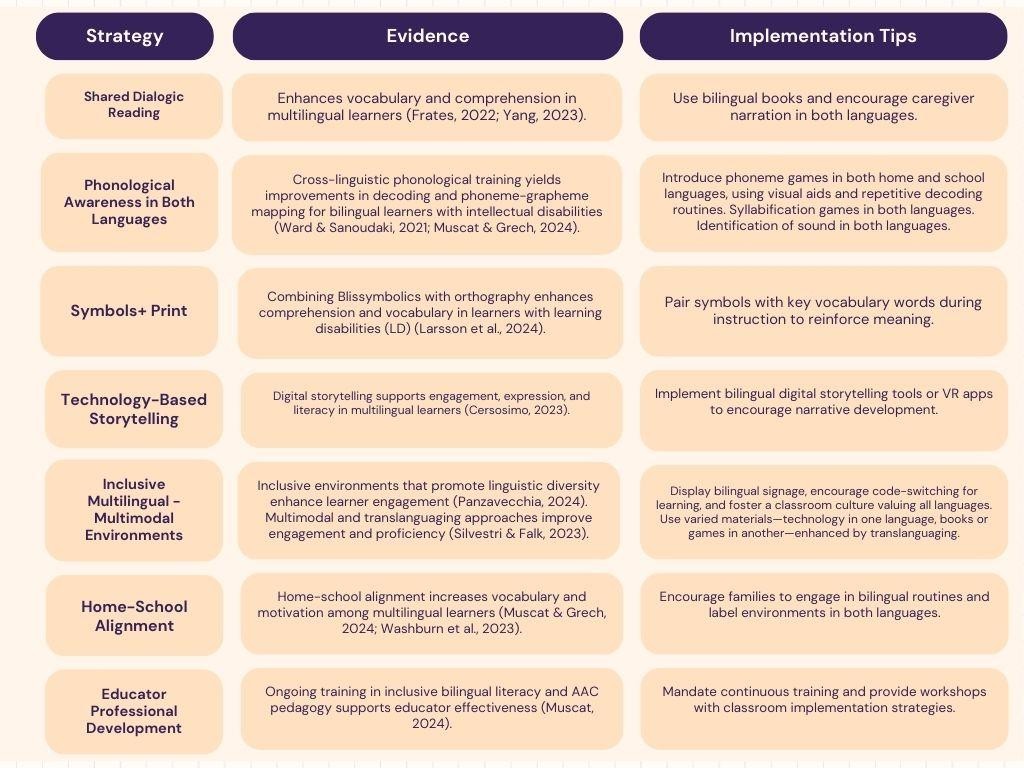
Based on empirical evidence and consistent with Maltese and international inclusion frameworks, the following strategies are proposed to enhance bilingual literacy instruction for learners with ID. These evidence-driven approaches recognise bilingual learners’ cognitive and communicative strengths while highlighting the importance of multimodal, adaptable, and context-aware instruction. Figure 1 summarises each strategy, its empirical foundation, and key implementation considerations.
Implementing these strategies through an intersectional lens requires more than simply adopting new instructional techniques; it involves embedding them within structures that recognise how disability, language, culture, and socio-economic background interact to influence learning opportunities (Bešić, 2020; García & Lin, 2017; Collins & Bilge, 2020). This means designing literacy activities that draw on students’ full linguistic repertoires, incorporating culturally relevant texts, and using assessment tools that are accessible in all languages of instruction (Hopewell & Abril-Gonzalez, 2019; Wawire & Barnes-Story, 2023). It also requires coordinated planning time for teachers, language specialists, and learning support educators to align instructional goals across languages, as well as leadership practices that actively address systemic inequities (Hernández Flores & Boveda, 2024). By integrating biliteracy practices within a broader commitment to equity and inclusion, schools can ensure that bi/multilingualism is treated as an instructional resource rather than a barrier, supporting learners with ID to develop the skills and confidence necessary for full participation in both educational and community contexts.
Figure 1 Strategies for Biliteracy for Students with ID
Assessment and Progress Monitoring
Assessment choices shape not only how educational progress is defined, but also how progress is recognised. Within current legal frameworks, the Individualised Education Plan (IEP) remains the primary tool for tracking growth for students with ID. However, policy analyses reveal a persistent disconnect between recommended instructional practices and the formal mechanisms for monitoring achievement (Muscat 2025, pre-print). This disconnect is particularly consequential for bilingual learners with ID, whose progress is often assessed separately in each language, with little recognition of cross-linguistic transfer or how home language use supports school-based learning.
An intersectional approach to assessment recognises that disability, language, culture, and family engagement intersect to influence both learning opportunities and outcomes. Effective monitoring, therefore, requires repeated, domain-specific indicators in both languages, alongside systematic documentation of the language used for instruction and assessment. This not only reflects authentic learning conditions but also provides a transparent, evidence-based foundation for decision-making (Zirkel & Yell, 2024). Importantly, IEPs should explicitly track bilingual development, record instances of translanguaging, and integrate culturally relevant texts that align with learners’ identities (Bešić, 2020; Hernández Flores & Boveda, 2024).
Family involvement must be ongoing rather than limited to post-report meetings; continuous collaboration ensures that assessment reflects the learner’s full communicative repertoire, including literacy practices at home. Expectations for progress should be matched to both the cognitive profile and linguistic resources of the learner, supported by multimodal strategies, and evaluated through repeated, dual-language measures that capture growth across contexts (Wawire & Barnes-Story, 2023).
Systemic Conditions for Sustainable Practice
Systemic alignment is essential. Embedding biliteracy practices for learners with ID within curriculum and assessment frameworks indicates a shift from viewing such learners as exceptions to recognising them as expected participants in bilingual inclusive education. However, for these frameworks to be meaningful, they must be accompanied by the material conditions necessary for implementation. These include protected planning time, parity of instructional resources across languages, including symbol-supported and digital materials, ongoing mentoring and supervision to build intersectional competence, and explicit language-of-instruction policies that guard against default monolingualism (Hernández Flores & Boveda, 2024; Rerri, 2022).
Educators require not only policy guidance to support bilingual decision-making in the classroom but also immediate access to high-quality, adaptable materials in all relevant languages. Biliteracy tools such as scaffolded readers, phonics resources, and assessment templates should be readily available “off the shelf” to ensure timely, efficient, and sustainable implementation for both educators and learners.
An Intersectional Biliteracy Agenda for Learners with ID
Growing evidence shows that bilingual literacy benefits learners with ID, which requires a decisive shift from monolingual traditions to linguistically adaptive policies. Initiatives in Malta exemplify both progress and areas for improvement. The National Literacy Strategy for All in Malta and Gozo (2021-2030) encourages daily reading in both Maltese and English, while the revised National Inclusion Policy (2022) reaffirms commitments to the United Nations Convention on the Rights of Persons with Disabilities. However, neither document explains how to implement bilingual literacy for students with cognitive diversity. As a result, school leaders and teachers face uncertainty, inconsistent practices, and persistent deficit assumptions (Muscat, 2024; Grande Gonzalez et al., 2024). European guidance is broader but remains unclear: the 2019 Council Recommendation on Languages calls for proficiency in two additional languages, and the European Pillar of Social Rights promotes inclusive education, but both lack specifics on disability sensitivity. To bridge the gap between policy and practice, six targeted actions are proposed,
Enact a national bilingual literacy framework for all learners.
Establish the role of all languages as means of instruction; integrate dual-language objectives into curriculum, assessment, and teacher standards. Research by Muscat and Grech (2023, 2024) indicates that organised bilingual programs promote cross-linguistic transfer, highlighting the necessity for widespread implementation across systems. Specific guidelines that include learners of all abilities should be outlined in policy, as both inclusion and literacy policies currently provide fragmented, generic guidelines.
Embed compulsory professional development in bilingual inclusion.
Preparation and continuous professional development should encompass multimodal literacy, cross-linguistic scaffolding, translanguaging, and the use of AAC. Training must follow a cyclic format, including induction, refresher courses, and quality assurance, enabling educators to build and sustain their confidence.
Implement bilingual assessments for all.
Replace monolingual assessments with dynamic, dual-language measures of phonology, memory, and reading; track learning potential rather than deficits. Speech-language pathologists, literacy specialists and psychologists should encourage the use of such tools to prevent mislabelling bilingual growth as a delay.
Allow adjustments in curriculum and ensure equal access to resources.
Literacy instruction for bilingual learners with ID frequently encounters resource-related barriers. In Maltese classrooms, the limited availability of Maltese-language literacy software often leads educators to rely on English-based platforms. These digital tools can offer structured, phonics-based guidance that strengthens decoding and phonological awareness. This is particularly valuable for Learning Support Educators (LSEs) without specialised literacy training, as such software provides evidence-based instructional sequences (Muscat, 2024). However, reliance on English alone risks marginalising students’ first or preferred home languages. To foster vocabulary development and conceptual understanding across languages, educators should supplement English resources with materials in Maltese and other home languages, drawing on research supporting cross-linguistic transfer (Muscat & Grech, 2025). A dynamic bilingual pedagogy must also include strategies such as code-switching, adult mediation, and materials tailored to learners’ cognitive profiles. Graphic organisers, visual-symbolic supports, and AI-enhanced platforms, offered in both languages, can significantly enhance access and engagement (Calvin & Gray, 2022, 2024). National guidelines should classify these tools as essential infrastructure rather than optional extras, ensuring that literacy programmes are adaptable and inclusive of minority languages.
Establish structured assistance for home-school literacy collaborations.
Policies should promote culturally relevant resources and workshops that support families in maintaining dual-language storytelling, dialogic reading, and print routines, which are associated with richer vocabulary and greater motivation in bilingual children with ID (Muscat & Grech, 2024). Incorporating translanguaging and home literacy practices boosts vocabulary and engagement. Leaders with intersectional competence can facilitate this process by providing bilingual communication tools, culturally sensitive workshops, and encouraging two-way literacy sharing between home and school (Hernández Flores & Boveda, 2024; Rerri, 2022; Valdés, 2019). As Bešić (2020) notes, such practices transform diversity from a reactive issue into a core value of inclusive literacy.
Enhance Bilingual Research in ID.
Although research on bilingual instruction for learners with ID is slowly gaining ground, further empirical studies remain crucial. Current evidence supports the use of multilingual, multimodal, and culturally responsive methods, moving beyond traditional models that often overlook the cognitive and linguistic strengths of these learners. To guide such practices, data should be systematically gathered and categorised by language backgrounds, disability profiles, and literacy outcomes. This enables more equitable resource distribution, reveals disparities, and facilitates the continuous refinement of policies. Future research should explore the long-term academic and social effects of dual-language instruction, with a focus on learner agency, identity, and self-expression. Longitudinal studies with inclusive assessment tools are essential for monitoring progress across multiple languages and settings. Furthermore, additional research is needed on the role of bilingual AAC systems in both classroom and home environments.
Conclusion
An intersectional perspective shows how culture, ability, and language are often marginalised in literacy education for learners with ID. The recommendations provided here are not exhaustive, but they offer meaningful guidance for policy and practice based on current research. Building biliteracy from the beginning, through clear, multimodal instruction; bilingual assessments aligned with teaching; and leadership rooted in intersectional competence, positions bilingualism as a vital educational asset. The Maltese context, when viewed alongside international evidence, demonstrates the feasibility of this approach and emphasises the structural conditions needed for its long-term sustainability.
In multilingual settings, decisions about which language to prioritise in instruction have tangible impacts on learners with ID. Students with an ID often already face cognitive, communicative, and learning challenges; removing one language of literacy instruction, often their home or community language, can significantly limit access to learning and expression. Such choices reduce opportunities for communication, hinder participation, and risk undermining students’ future independence. If the aim is to prepare learners to function confidently within bilingual communities, then restricting their linguistic tools is not just limiting; it is actively disabling. Inclusive literacy must therefore recognise bilingualism as a right and a necessity, seeing it as central to equitable and meaningful education.
References
- Beatty, L., Acar, S., & Cheatham, G. A. (2021). Translanguaging in inclusive classrooms: Learning with children and families. Journal of Early Intervention and Exceptional Children, 87(2), 145–161. https://doi.org/10.1177/10962506211002536
- Bešić, E. (2020). Intersectionality: A pathway towards inclusive education? Prospects,49, 111–122. https://doi.org/10.1007/s11125-020-09461-6
- Calvin, K. L., & Gray, S. (2022). Double-Bubble Thinking Maps and Their Effect on Reading Comprehension in Spanish-English Bilingual Middle School Students With Learning Disabilities. Learning Disability Quarterly, 45(3), 212–224.
- Calvin, K. L., & Gray, S. (2024). Improving Expository Text Comprehension in Adolescent Spanish–English Bilingual Learners With Learning Disabilities Using a Graphic Organizer. Learning Disability Quarterly, 47(3), 154–166.
- Cioè-Peña, M. (2020). Bilingualism for students with disabilities, deficit or advantage?: Perspectives of Latinx mothers. Bilingual Research Journal, 43(3), 253–266. https://doi.org/10.1080/15235882.2020.1799884
- Collins, P. H., & Bilge, S. (2020). Intersectionality (2nd ed.). Polity Press.
- Convention on the Rights of Persons with Disabilities. (2023) Report of the sixteenth session of the Conference of States Parties to the Convention on the Rights of Persons with Disabilities. Conference of States Parties to the Convention on the Rights of Persons with Disabilities. https://documents.un.org/doc/undoc/gen/n23/240/10/pdf/n2324010.pdf
- Crenshaw, K. (1989). Demarginalising the intersection of race and sex: A Black feminist critique of antidiscrimination doctrine, feminist theory and antiracist politics. University of Chicago Legal Forum, 1989(1), 139–167. https://chicagounbound.uchicago.edu/uclf/vol1989/iss1/8
- EURYDICE (2025) Special education needs provision within mainstream education. Retrieved May 25, 2025, from https://eurydice.eacea.ec.europa.eu/eurypedia/malta/special-education-needs-provision-within-mainstream-education
- Faltis, C. J. (2019). Pedagogical codeswitching and translanguaging in bilingual schooling contexts. In Codeswitching in the classroom (pp. 59–78). Routledge. https://library.oapen.org/handle/20.500.12657/77147
- Frates, A., Spooner, F., Collins, B. C., & Running Bear, C. (2022). Vocabulary Acquisition by Multilingual Students With Extensive Support Needs During
- Shared Reading. Research and Practice for Persons with Severe Disabilities, 47(3), 137-154. https://doi.org/10.1177/15407969221113590
- Frates, A., Spooner, F., Collins, B., & Peterson, P. (2024). The Effects of an Instructional Package on Reading Skills for Multilingual Learners With Extensive Support Needs. Research and Practice for Persons with Severe Disabilities, 49(3), 190-207. https://doi.org/10.1177/15407969241247815
- García, O., & Kleifgen, J. A. (2018). Educating emergent bilinguals: Policies, programs, and practices for English learners. Teachers College Press.
- García, O., & Lin, A. M. Y. (2017). Translanguaging in bilingual education. In O. García,A. M. Y. Lin, & S. May (Eds.), Bilingual and multilingual education (pp. 117–130). Springer. https://doi.org/10.1007/978-3-319-02258-1_9
- Gilhuber, C. S. (2023). Home Literacy Experiences of Preschool Children on the Autism Spectrum Growing Up in Multilingual Contexts. Doctoral Dissertation. https://etda.libraries.psu.edu/catalog/20102csg5318
- Grande Gonzalez, E., Rodriguez Robles, A., Zavala Lara, C. et al. (2024) Implementation of MTSS when supporting emergent bilinguals: Findings and recommendations. Contemp School Psychol. https://doi.org/10.1007/s40688-024-00516-5
- Hernández Flores, M. L., & Boveda, M. (2024). Beyond the demographics of the special education workforce: Developing intersectional competence to sustain teachers of color. Journal of Cases in Educational Leadership, 27(4), 36–46. https://doi.org/10.1177/15554589241288868
- Hopewell, S., & Abril-Gonzalez, P. (2019). ¿Por qué estamos code-switching? Understanding language use in a second-grade classroom. Bilingual Research Journal, 42(1), 27–43. https://doi.org/10.1080/15235882.2018.1561554
- Jessner, U., & Allgäuer-Hackl, E. (2025). Rethinking code-switching and translanguaging as language management strategies. In The Wiley handbook of multilingual language learning (Ch. 9). Wiley. https://doi.org/10.1002/9781394165957.ch9
- Larsson, A., Johnson, E., Kuyler, A., & Jennische, M. (2025). A key to literacy? Exploring Bliss words combined with traditional orthography as a teaching strategy for language and literacy learning for learners with learning disabilities. Support for Learning, 40(1), 32–44. https://doi.org/10.1111/1467-9604.12514
- Lee, K., Cascella, M., & Marwaha, R. (2023, June 4). Intellectual disability. In StatPearls.StatPearls Publishing. https://www.ncbi.nlm.nih.gov/books/NBK547654/
- Li, L. (2022). Teacher Agency for the Inclusion of Dual Language Learners with Disabilities: Stories of Chinese-English Dual Language Immersion School Teachers. The University of Wisconsin-Madison. https://www.proquest.com/openview/6c7fdb5f863138ee0cc7de8b66791bd9/ 1?pq-origsite=gscholar&cbl=18750&diss=y
- Martínez-Álvarez, P. (2018). Dis/ability labels and emergent bilingual children: current research and new possibilities to grow as bilingual and biliterate learners. Race Ethnicity and Education, 22(2), 174–193. https://doi.org/10.1080/13613324.2018.1538120
- Martin, S., Hodder, C., Merritt, E., Culliton, A., Pottie, E., & Kay-Raining Bird, E. (2021). Bilingual outcomes for a student with Down Syndrome in French immersion. Journal of Immersion and Content-Based Language Education, 9(2), 223–251. https://doi.org/10.1075/jicb.20011.mar
- Ministry for Education, Sports and Research Innovation, Malta (2021) A National Literacy Strategy for all in Malta and Gozo, 2021 -2030.https://sustainabledevelopment.gov.mt/wp-content/uploads/2024/10/A-National-Literacy-Strategy-for-All-in-Malta-and-Gozo-2021-2030.pdf
- Ministry for Education, Sports and Research Innovation, Malta (2022) A Policy on Inclusive Education in Schools. A route to quality inclusion. https://student-wellbeing-services.gov.mt/wp-content/uploads/2024/08/Policy-on-Inclusive-Education-in-Schools.pdf
- Moraczewska, A. (2024). Pedagogical translanguaging for epistemic inclusion: Scaffolding strategies in bilingual subject instruction in Norway. International Journal of Applied Linguistics, 34(1), 97–116. https://doi.org/10.1111/ijal.12661
- Muscat, L. (2024). Voices of inclusion: Perspectives from Maltese education stakeholders. European Journal of Inclusive Education, 3(1), 101-118. https://doi.org/10.7146/ejie.v3i1
- Muscat, L. & Grech, H. (2023) Nonword reading and other reading-related skills in Down syndrome. Journal of Research in Special Educational Needs, 00, 1– 19. Available from: https://doi.org/10.1111/1471-3802.12604
- Muscat, L. & Grech, H. (2023). An Evaluation of the Maltese school literacy environments and practices of students with Down Syndrome. Paris Conference of Education (IAFOR), Conference Proceedings. https://doi.org/10.22492/issn.2758-0962.2023.22
- Muscat, L., & Grech, H. (2024). The home literacy environment of individuals with Down Syndrome. A comparative study within a bilingual context. International Journal of Bilingual Education and Bilingualism, 1–16. https://doi.org/10.1080/13670050.2024.2439277
- Muscat, L., & Grech, H. (2025). Deciphering biliteracy in Down syndrome: Insights from a Maltese-English bilingual setting. International Journal of Bilingualism, https://doi.org/10.1177/13670069251355478
- Muscat (2025 pre-print). Mapping Literacy Practices in Bilingual Contexts for Individuals with Intellectual Disabilities: A Scoping Review. Open Science Framework. https://doi.org/10.17605/OSF.IO/QTBWG
- Oshchepkova, E. S., Kartushina, N. A., & Razmakhnina, K. O. (2023). Bilingualism and Development of Literacy in Children: A Systematic Review. Psychology in Russia: state of the art, 16(1), 3–25. https://doi.org/10.11621/pir.2023.0101
- Panzavecchia, M. (2024). Unveiling Post-Colonial Perspectives: Primary Educators’ Insights on Teaching English in Multilingual Malta. Conference Proceedings. Innovation in Language Learning 2024. https://conference.pixel-online.net/library_scheda.php?id_abs=6816
- Rerri, G. E. (2022). Lived experiences of bilingual and special education teachers of Spanish-speaking emergent bilinguals with disabilities: The impact of the students’ intersectionality [Doctoral dissertation]. University of Houston-Clear Lake. ProQuest Dissertations Publishing. https://uhcl-ir.tdl.org/items/5f33ce2b-41f7-4ec0-a826-e2b7e6299a65
- Romero, C., & Uddin, L. Q. (2021). Bilingualism, Executive Function, and the Brain: Implications for Autism. Neurobiology of Language, 2(4), 513. https://doi.org/10.1162/nol_a_00057
- Sefotho, M. P. (2019). Strategies for reading development among Sesotho-English bilinguals: Efficacy of translanguaging (Doctoral dissertation, University of the Witwatersrand). https://wiredspace.wits.ac.za/handle/10539/28006
- Shand, L. W. S. (2024). Teachers’ Perceptions of Academic Success for Multilingual Learners With Learning Disabilities: A Qualitative Explanatory Case
- Study [Doctoral dissertation, American College of Education]. https://scholarworks.ace.edu/items/efb7f716-c239-4483-9e40-383675edb6ed
- Silvestri, J., & Falk, J. L. (2023). A Transition to Multimodal Multilingual Practice: From SimCom to Translanguaging. Languages, 8(3). https://doi.org/10.3390/languages8030190
- UNESCO. (2025). Multilingual education: A key to quality and inclusive learning. Retrieved May 26, 2025, from https://www.unesco.org/en/articles/multilingual-education-key-quality- and-inclusive-learning
- United Nations. (2013). Convention on the Rights of Persons with Disabilities. https://www.un.org/disabilities/documents/convention/convoptprot-e.pdf
- Valdés, G. (2019). Sandwiching, polylanguaging, translanguaging, and codeswitching. In Codeswitching in the classroom (pp. 134–152). Routledge. https://library.oapen.org/handle/20.500.12657/77147
- Ward, R., & Sanoudaki, E. (2020). Bilingualism in children with a dual diagnosis of Down syndrome and Autism Spectrum Disorder. Clinical Linguistics & Phonetics, 35(7), 663–689. https://doi.org/10.1080/02699206.2020.1818288
- Washburn, E. K., Gesel, S. A., Fitzgerald, M. S., Beach, K. D., & Kingsbery, C. R. (2023). The Impact of a Comprehensive, Evidence-Based Approach to Summer Literacy Intervention on the K-3 Reading Skills of Economically and Culturally Diverse Students. Reading & Writing Quarterly, 39(6), 510–529. https://doi.org/10.1080/10573569.2022.2147463
- Wawire, B. A., & Barnes-Story, A. (2023). Translanguaging for multiliteracy development: Pedagogical approaches for classroom practitioners. International Journal of Bilingual Education and Bilingualism. https://doi.org/10.1080/13670050.2022.2094702
- Yang, D. (2023). Reading with Children on the Autism Spectrum: The Experiences of Bilingual Chinese Canadian Immigrant Families. https://qspace.library.queensu.ca/items/b0a98847-2e78-4ea9-8374-188176d4cb92
Funding
This paper forms part of a research initiative funded by the REACH HIGH II Scholars Agreement. Reference number: MEYR 408/2024/3.